

PIM vs MDM - What’s the Difference and Which One Should You Choose?
Compare PIM vs MDM to understand their roles, use cases, architecture, and data requirements. Developcoins helps businesses choose the right approach for managing product and enterprise data at scale.
Managing business data becomes difficult when information is spread across multiple systems, teams, and sales channels. Product descriptions may differ between platforms, customer records may be duplicated, and important updates can take too long to reach the right systems.
This is where Product Information Management (PIM) and Master Data Management (MDM) come into the picture. Both help businesses bring greater control over their data, but they solve different problems. Choosing between them starts with understanding where the actual data challenge sits and what the business needs the system to accomplish.
Understanding Your Data Environment Before Choosing a Solution
Data problems rarely start as major technology issues. They often begin with small inconsistencies that become harder to manage as the business grows. A product team may update one system while another channel continues showing older information. Marketing, sales, and operations may also rely on different records, creating duplicated work, manual corrections, and inconsistent data.
For companies managing thousands of products, multiple sales channels, or several connected business systems, spreadsheets and disconnected tools become harder to manage. The first step is identifying which data needs better control and how it moves across the business.
What is PIM and MDM? How It Solves Different Parts of the Same Data Problem?
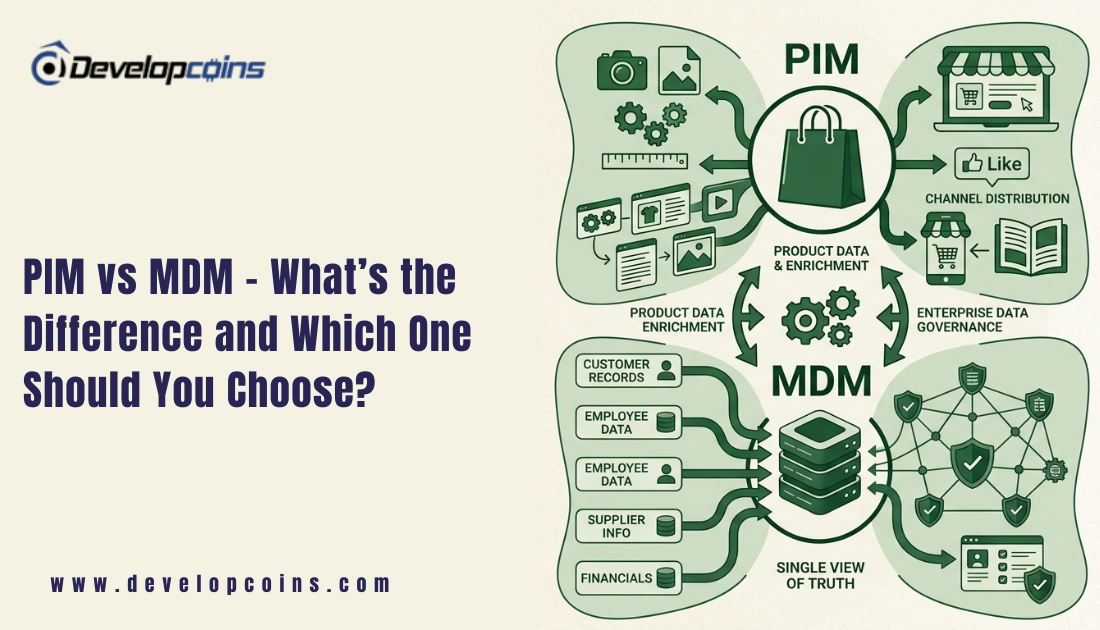
PIM and MDM overlap in some areas, particularly around product data, but their scope is different.
PIM is product-centric. It brings product names, descriptions, specifications, images, attributes, categories, and other information into a controlled environment. Teams can then organize, enrich, approve, and distribute this information across different channels.
MDM is enterprise-centric. It helps establish reliable master records across data domains such as products, customers, suppliers, locations, and other important business entities.
A useful distinction is:
PIM - Manage and prepare product information for consistent use across channels.
MDM - Establish trusted, governed master data across business systems and departments.
That distinction provides the foundation for deciding which approach fits the business.
Where PIM Fits When Product Information Is Holding You Back
PIM becomes valuable when product information is at the center of the problem. A PIM platform can bring product names, descriptions, specifications, images, attributes, categories, and other content into a structured environment. Teams can then enrich and approve information before distributing it to websites, marketplaces, catalogs, mobile applications, and other channels.
This is particularly useful for retailers, manufacturers, distributors, and e-commerce businesses with large or frequently changing product catalogs. Instead of updating product information separately across different channels, teams can work from a central product-information source. The main value of PIM is around product information quality, enrichment, governance, and distribution rather than managing every type of business data.
Where MDM Comes In When Data Spreads Across the Business
MDM becomes more relevant when the problem extends beyond product content. A growing organization may have customer data in a CRM, product records in an ERP, and supplier information in another application. Operational data may also be spread across additional systems, making consistency harder to maintain.
MDM brings governance and consistency to these different data domains.The goal is not simply to store information in one place. It is to establish reliable master records and define clear ownership and governance rules. MDM can also help identify duplicates, maintain relationships between data entities, and keep important business systems aligned.
For organizations with complex operations and multiple departments, this broader data strategy can become more important than product-content management alone.
How the Choice Changes Your Data Architecture
The difference between PIM and MDM becomes more important when planning how data moves between business systems.
A PIM-Led Architecture
A PIM-led architecture is built around product information and its movement across customer-facing channels. Product data may come from an ERP or another source system and move into the PIM for enrichment, classification, and approval.
For some businesses, PIM may work alongside existing enterprise systems.
From there, the prepared information can be distributed to:
- E-commerce platforms
- Marketplaces
- Websites and mobile applications
- Digital catalogs
- Other sales channels
An MDM-Led Architecture
An MDM-led architecture takes a broader approach to business data. It can connect multiple systems around trusted master records and defined data ownership. For others, MDM may provide the broader data foundation, with PIM handling the product-specific layer.
This may involve:
- ERP and CRM systems
- Commerce platforms
- Operational applications
- Analytics platforms
- Supplier and customer data sources
This technology decision should reflect where data originates, who owns it, how it changes, and which systems depend on it.
What If You Need Both?
PIM and MDM do not always have to compete. A business with complex product catalogs and enterprise-wide data requirements may use both. MDM can provide the broader master-data foundation, while PIM can handle detailed product enrichment and prepare product information for customer-facing channels.
This approach can be useful when product data needs deeper content management than the wider master-data environment provides. The important part is defining how the two systems interact and which system owns each data element. Clear integration rules are also needed to determine how information moves between the two environments.
Before You Choose, Look at These Five Things
The technology decision should follow the business requirements rather than the other way around. The architecture should support this growth without creating another fragmented environment.
1. Data complexity - Identify the number and types of records being managed. A product catalog presents a different challenge from an environment involving products, customers, suppliers, and locations.
2. Existing systems - Map the ERP, CRM, e-commerce platforms, databases, internal applications, and other systems that create or consume business data.
3. Channels and entities - Consider how many products, customers, suppliers, locations, and sales channels need to stay aligned.
4. Integration requirements - Determine where APIs, synchronization, workflows, approvals, and data exchange will be required.
5. Future growth - Consider new products, markets, channels, systems, and data domains that may be added later.
Turn Your Data Problem Into a PIM or MDM Roadmap
PIM and MDM are not interchangeable solutions. PIM is primarily concerned with managing, enriching, and distributing product information, while MDM provides a broader approach to trusted master data across the organization.
Some businesses may need PIM alone. Others may require MDM, while larger data environments may benefit from both working together. The right starting point is a clear assessment of your data sources, workflows, systems, integrations, ownership, and future requirements.
Developcoins, a Cryptocurrency development company with 10+ years of experience, provides crypto solutions and services alongside custom platform development, API integrations, data-driven applications, and scalable digital infrastructure. Its development capabilities can support businesses working with complex data, connected systems, and evolving digital workflows.
If your organization is dealing with fragmented product or master data, discuss your requirements with the Developcoins team and turn those challenges into a practical implementation roadmap.

THE AUTHOR
DEVELOPCOINS EDITORIAL TEAM
Our Developcoins' Editorial Team brings over 10+ years of experience in blockchain, fintech, and AI-based technologies. We are a team of developers, analysts, and technical writers sharing insights from successful projects. We believe content should do more than inform. It should guide, clarify, and give readers the confidence to explore new technologies. To support this, we publish content backed by practical knowledge gained from working on live projects across industries.
 CEX vs DEX Development: Which Should You Build and Why?