

CEX vs DEX Development: Which Should You Build and Why?
Planning a crypto exchange? Developcoins explains CEX, DEX, and hybrid models, covering liquidity, architecture, trading, wallets, and development planning.
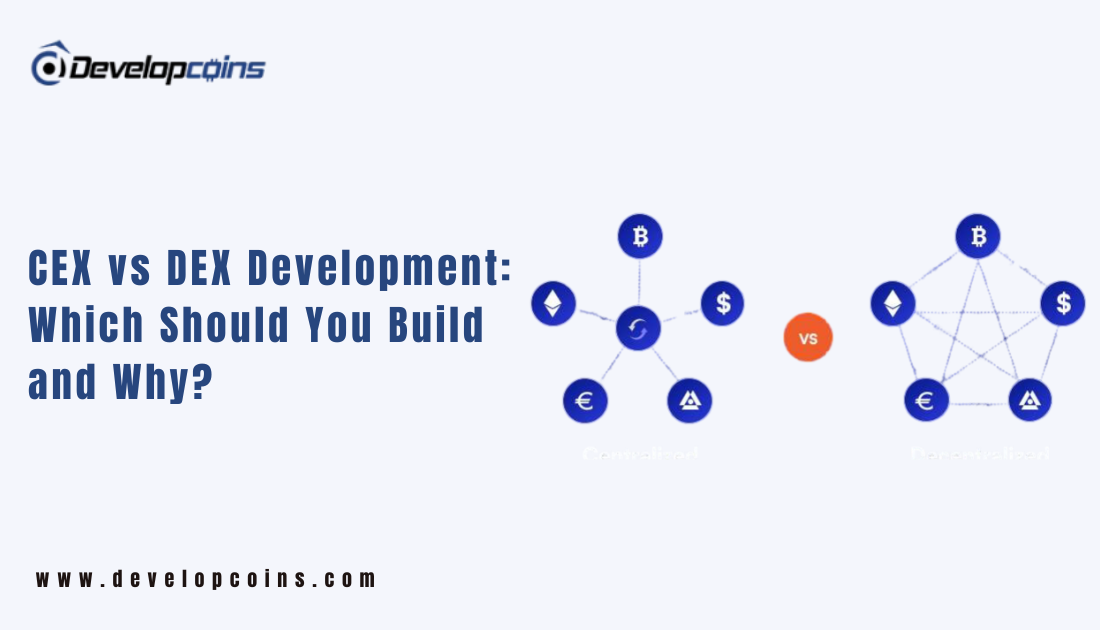
Choosing between centralized and decentralized exchange development is not simply a technology decision. It determines how users trade, how assets are handled, how liquidity enters the platform, and how much control the business retains.
For a founder planning a crypto exchange, the right model depends on the product being built, the users it needs to serve, and the trading experience the platform should deliver. Making that decision before development starts can prevent unnecessary architectural changes later.
Start With the Business You Want to Build
The first decision should be the trading experience the business wants to create.
A CEX can suit a platform built around managed accounts, centralized liquidity, advanced trading tools, and greater operational control. A DEX can make more sense for products centered on self-custody, wallet connectivity, smart contract, and on-chain trading. Some businesses may need both.
So, start by defining who the exchange is for, what users need to trade, how assets will be handled, where liquidity will come from, and how much control the business needs over the platform. These requirements provide a stronger foundation for choosing the exchange model
Where CEX and DEX Take Different Paths
The key difference is who controls the assets, how the trade is executed, and where responsibility for that process sits.
CEX - Centralized Control and Managed Trading
A Centralized exchange development typically uses platform-managed accounts and wallets, giving the business control over assets, listings, trading pairs, fees, liquidity, and the overall trading experience.
Its infrastructure can include a matching engine, order management, trading APIs, liquidity integrations, and fiat services. In return, the business takes on greater responsibility for custody, security, compliance, monitoring, and platform operations.
DEX - Self-Custody and On-Chain Trading
A Decentralized exchange development generally lets users connect their own wallets and trade through smart contracts, liquidity pools, aggregators, or on-chain order books.
Its development centers on wallet connectivity, blockchain integration, smart contracts, liquidity, and transaction routing. This suits DeFi and Web3 products but also places greater technical responsibility on smart contract security, network selection, gas costs, and transaction execution.
When a CEX Gives You the Control You Need
A CEX is a strong fit when the business needs closer control over the trading environment and platform operations. It can suit businesses that want a familiar account-based experience with managed custody and centralized trading.
Key advantages include:
- Greater control over users, listings, and trading pairs
- Managed custody and centralized liquidity
- Advanced trading and account-based features
- Control over fees and platform-level services
The trade-off is greater operational responsibility. The business must plan for custody security, transaction monitoring, compliance, user data, and ongoing infrastructure management.
When a DEX Fits the Product Better
A DEX fits products where self-custody and on-chain execution are central to the user experience. It can suit DeFi development platforms, token ecosystems, and Web3 applications where users prefer connecting their own wallets.
Key advantages include:
- User-controlled assets and wallet-based access
- On-chain trade execution
- Access to decentralized liquidity mechanisms
- Support for DeFi-focused trading experiences
The technical priorities shift toward smart contract security, blockchain selection, wallet compatibility, gas costs, transaction execution, and liquidity management. These requirements should be considered from the beginning of development.
When CEX and DEX Features Need to Work Together as Hybrid Exchange?
Not every exchange needs to choose between fully centralized or fully decentralized infrastructure. A hybrid exchange development can provide a broader foundation than committing entirely to one model from the start.
A hybrid exchange can combine elements of both models when the business wants centralized platform control alongside on-chain trading or self-custody options. This model can suit broader Web3 development based trading ecosystems where different user groups may need different ways to trade and manage assets.
A hybrid model can bring together:
- Centralized and on-chain trading components
- Multiple liquidity sources
- Flexible custody and settlement options
- Wallet-based and account-based user experiences
The trade-off is greater architectural complexity. The platform needs clear boundaries between centralized and decentralized components, along with careful planning for liquidity, security, wallet connectivity, transaction routing, and data flows.
Liquidity Can Make or Break the Exchange
Choosing the exchange architecture is only part of the decision. The platform also needs a practical liquidity strategy.
For a CEX, liquidity may come from market makers, external liquidity providers, connected exchanges, or internal liquidity systems. For a DEX, liquidity can come through pools, market makers, aggregators, and other on-chain mechanisms.
The chosen model affects:
- Trading depth
- Slippage
- Execution quality
- Supported trading pairs
- Asset availability
A strong interface cannot compensate for consistently poor trading conditions. Liquidity, therefore, needs to be planned alongside the exchange architecture, not added as an afterthought.
Plan the Right Architecture Before Development
Once the business model, trading experience, and liquidity strategy are defined, the technical requirements become easier to map.
A CEX development roadmap may include
Core trading - Matching engine, order management, trading pairs, and APIs.
Wallet infrastructure - Deposit, withdrawal, custody, hot and cold crypto wallet management.
Platform operations - User accounts, admin controls, KYC workflows, transaction monitoring, and reporting.
Security - Access controls, wallet security, encryption, monitoring, testing, and infrastructure protection.
A DEX development roadmap may include
Trading infrastructure - A smart contract development, swap logic, order execution, and routing.
Blockchain layer - Network integration, node connectivity, token standards, and transaction handling.
Wallet layer - Wallet connection, transaction signing, balances, and user-controlled asset management.
Liquidity layer - Pools, aggregators, market makers, pricing mechanisms, and supported trading pairs.
The important point is that these components should be designed together. Choosing the exchange type first and figuring out the architecture later can create unnecessary rework.
Build the Right Exchange From the Start
Your exchange model should be based on what the platform needs to achieve, not simply on whether CEX, DEX, or hybrid infrastructure is more popular.
Share your exchange concept, target users, trading model, preferred assets, and core requirements with Developcoins, a crypto exchange development company providing CEX development, DEX development, hybrid exchange development, crypto wallet development, smart contract development, blockchain development, and liquidity solutions. Its team can help map the right architecture, feature set, integrations, and development roadmap for your exchange.

THE AUTHOR
DEVELOPCOINS EDITORIAL TEAM
Our Developcoins' Editorial Team brings over 10+ years of experience in blockchain, fintech, and AI-based technologies. We are a team of developers, analysts, and technical writers sharing insights from successful projects. We believe content should do more than inform. It should guide, clarify, and give readers the confidence to explore new technologies. To support this, we publish content backed by practical knowledge gained from working on live projects across industries.