

Blockchain in E-commerce - How It’s Changing Payments, Trust, & Supply Chains
Discover how blockchain is changing e-commerce payments, product verification, supply-chain tracking, and smart contracts, with insights from Developcoins for businesses.
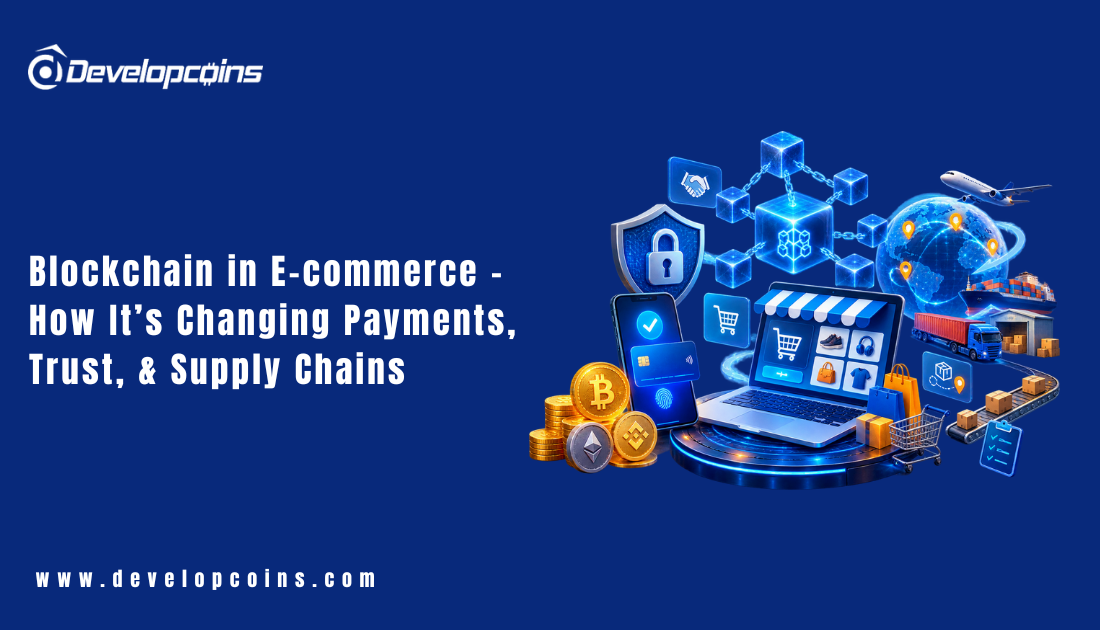
Though it all seems easy enough to customers, behind order fulfillment, the payment method, inventory, suppliers, product information and delivery there’s so much that is dealt within the different systems. Managing this system where each is a different entity becomes impossible, and hence tracking details and solving them would become quite impossible.
Blockchain offers another way to connect these processes through shared and verifiable records. Its use in e-commerce covers payments, product authentication, supply-chain tracking, smart contracts, and digital ownership.
Blockchain in E-commerce - Why Businesses Are Paying Attention?
E-commerce solutions almost involve a few systems running. The store is managing orders, while payment providers process transactions, the warehouses manage stock, and logistics partners will keep up with shipments.
Blockchain would be used to record necessary information on a network, where those with access can check it. When businesses work with several suppliers, vendors, and shipping partners, they’re capable of creating valuable records using shared data on a blockchain.
How Blockchain Works in an E-commerce Business
Blockchain records transactions across a network, creating a history that is difficult to alter without detection. Smart contract adds automation by carrying out predefined actions when certain conditions are met.
A Simple Process
- A customer places an order.
- The transaction is recorded according to the platform's blockchain architecture.
- A smart contract checks conditions such as payment or delivery.
- The required payment or settlement action is triggered.
- Product and shipment events can be recorded along the supply chain.
- Authorized participants can verify relevant records.
An crypto wallet development can handle blockchain transactions, while tokens can support rewards, digital assets, or ownership models.
How Blockchain Is Changing E-commerce Payments
Payments are one of the clearest blockchain applications for online businesses.
Crypto and Stablecoin Payments
E-commerce platforms can accept cryptocurrencies or stablecoins alongside traditional payment methods. This can be useful for businesses serving customers across international markets.
Cross-Border Transactions
International payments can involve multiple intermediaries, currencies, and settlement stages. Blockchain-based payments can simplify certain transaction flows by moving value directly across a blockchain network.
Automated Refunds and Settlements
An smart contract development can support predefined payment conditions. For example, funds can be released after a delivery condition is met, or a refund can be triggered according to an agreed rule.
How Blockchain Builds Trust Across E-commerce
One of the biggest factors that influence consumers to purchase online is Trust. Customers want certainty that goods are authentic, that the seller has identity, and they want to be sure that there are no mistakes when transaction data are input.
Blockchain is ideal to construct a transparent history of a product throughout the product Lifecycle from production, through distribution, until it reaches its final destination. This can help businesses provide verifiable information about product origin and authenticity. This is particularly important for luxury items, collectibles, high-value goods and products prone to counterfeting which could damage sales and reputation.
Blockchain does not eliminate fraud on its own, but tamper-resistant records can make certain forms of manipulation more difficult and provide stronger transaction histories.
Blockchain in E-commerce Supply Chain Management
Supply chains include multiple players, like manufacturers, distributors, warehouses, and consumers. Each player can own their data, so it’s impossible for products to have clear product provenance data and be traced and adjusted in a timely manner, especially dealing with fake products.
Blockchain allows multiple stakeholders to hold a shared record for events in the supply chain process, including product manufacturing, transportation, storage, and delivery. These records also include data, such as the product's source, manufacturer, warehouse management, transportation management, and delivery management, and identify potential counterfeit products more easily.
Real-World Case Studies & Industry Examples
Blockchain is already being used by major businesses to address practical e-commerce needs, from supply-chain tracking to product authentication and digital payments.
Walmart for Supply-Chain Tracking
Walmart uses Hyperledger Fabric to improve food traceability and track supply-chain information across suppliers, helping retrieve product data much faster than traditional methods.
LVMH & Aura for Product Authenticity
LVMH, through the Aura Blockchain Consortium, uses blockchain-based digital certificates to verify luxury products and provide provenance information, helping address counterfeiting.
Shopify with Stablecoin Payments
Shopify has introduced stablecoin development based payment capabilities through blockchain integrations, giving merchants another option for digital payments and settlements, particularly for international transactions.
What Are the Business Benefits of Blockchain in E-commerce?
The value of blockchain becomes clearer when its technical capabilities are connected to everyday business outcomes.
Greater transaction visibility - Shared records can make transactions easier to track across participating parties.
Less manual processing - Smart contracts can automate repetitive activities such as settlements and predefined payment workflows.
Better supply-chain control - Product records can provide greater visibility into movement, origin, and ownership.
More payment options - Crypto and stablecoin payments can give customers additional ways to complete transactions.
Stronger fraud controls - Tamper-resistant records can make certain forms of transaction and product manipulation harder.
New loyalty opportunities - A Token development based model can support rewards, digital ownership, and new customer engagement experiences.
What Does Blockchain E-commerce Development Require?
A blockchain e-commerce solution needs the right architecture, integrations, and security plan.
The development scope may include:
- Blockchain architecture
- Smart contracts
- Payment and wallet integration
- Supply-chain modules
- Admin and customer interfaces
- API integrations
- Security and compliance
- Testing and maintenance
The blockchain layer may also need to connect with existing payment gateways, ERP systems, CRM platforms, inventory tools, logistics APIs, and e-commerce software.
Build a Blockchain-Powered E-commerce Solution
Blockchain can add real value to e-commerce when it is used for the right business needs, whether that means supporting digital payments, verifying products, tracking the supply chain, or automating transactions through smart contracts.
If you are planning to bring these capabilities into an existing platform or build a new blockchain-based e-commerce solution, Developcoins, a Blockchain development company, can help turn the idea into a workable solution. Its services include blockchain development, smart contract development, crypto payment integration, and crypto wallet development, with solutions built around the business model and required features.
If you have a blockchain e-commerce idea in mind, you can share your requirements with us to discuss the right technology, features, integrations, and development scope for your project.

THE AUTHOR
DEVELOPCOINS EDITORIAL TEAM
Our Developcoins' Editorial Team brings over 10+ years of experience in blockchain, fintech, and AI-based technologies. We are a team of developers, analysts, and technical writers sharing insights from successful projects. We believe content should do more than inform. It should guide, clarify, and give readers the confidence to explore new technologies. To support this, we publish content backed by practical knowledge gained from working on live projects across industries.
 LOC Orders in Crypto Exchanges - A Guide to Implementation