

LOC Orders in Crypto Exchanges - A Guide to Implementation
Discover what LOC orders are, where they fit in 24/7 crypto markets, how exchanges implement them, the infrastructure they need, and how Developcoins can support advanced crypto exchange development.
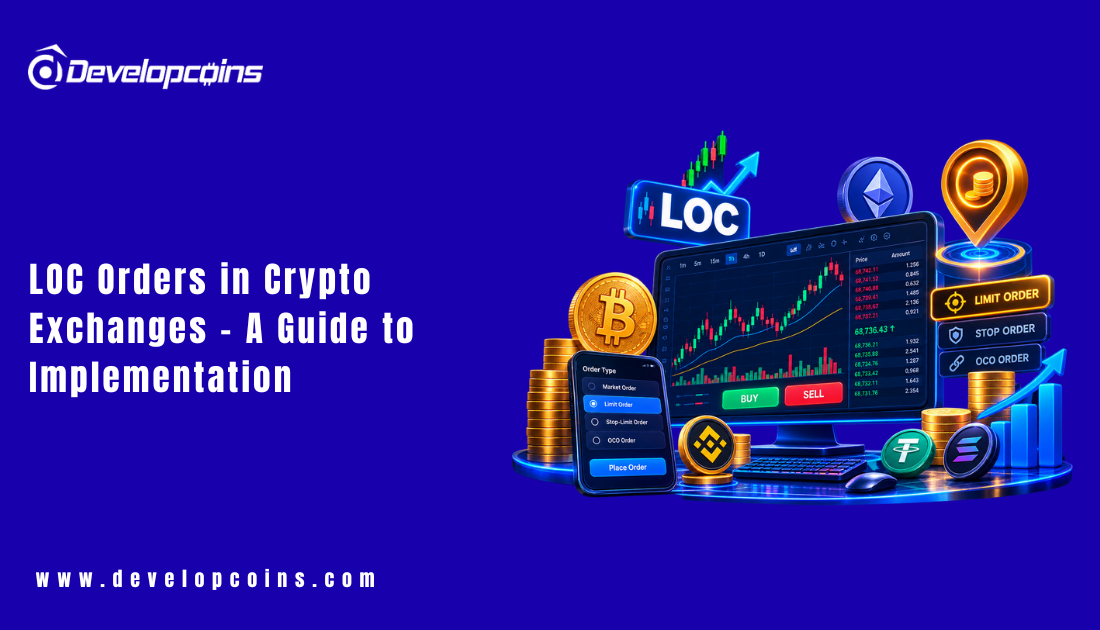
A trader may know the price they want, but timing can matter just as much. When a trade needs to happen around a specific market close, a regular limit order may not provide the right execution approach. This is where an LOC (Limit-on-Close) order comes in. Understanding how it works and what it takes to add this functionality can help exchange businesses plan a more capable trading environment without complicating the experience for users.
What Is an LOC Order?
An LOC (Limit-on-Close) order is a limit order designed to execute during a defined closing process at the trader’s specified price or better. The trader sets the asset, quantity, and limit price, while the exchange applies its closing rules.
Apart from a regular limit order, an LOC order is tied to a specific closing event. For crypto exchanges, this requires a defined closing window, auction period, or settlement point since crypto markets operate 24/7.
Where LOC Orders Make Sense in a 24/7 Crypto Market?
Crypto markets operate 24/7, so they do not have a universal market close like traditional exchanges. This makes LOC implementation different from simply copying an existing order model.
For a crypto exchange, the first step is defining what “close” means. It could be a scheduled daily close, auction window, index calculation, or settlement event.
That decision directly affects how LOC orders are accepted, queued, matched, and settled. The exchange may need logic for:
- LOC submission and cutoff times
- Order validation and eligibility
- Execution priority
- Closing-price calculation
- Partial or unfilled orders
- Trade recording and settlement
This makes LOC functionality a market-structure and exchange-architecture decision, not just another trading-interface feature.
LOC Order vs. Limit Order vs. Market Order
LOC orders differ from the standard order types found on most crypto exchanges. A market order prioritizes immediate execution against available liquidity, while a limit order gives traders control over the price at which they are willing to buy or sell.
An LOC order combines price control with a defined closing process. Rather than remaining active throughout regular trading, it is tied to the exchange’s specified closing mechanism.
For crypto exchange operators, this difference affects the underlying trading logic. Each order type requires its own validation, matching, and execution rules, meaning LOC functionality must be supported across the exchange’s trading infrastructure.
How Does an LOC Order Work Inside a Crypto Exchange?
An LOC order moves through a defined process, from placement and validation to matching and settlement.
1. Order placement
The trader selects LOC, enters the trading pair, quantity, and limit price, and submits the order through the exchange interface.
2. Price and execution conditions
The exchange validates the order against its rules, including price limits, minimum quantity, trading pair, account permissions, and closing window.
3. Matching with the order book
Eligible LOC orders enter the matching or auction mechanism, where buy and sell orders are evaluated according to the exchange’s execution rules.
4. Execution and settlement
Once the closing price is established, eligible orders are executed. Filled trades are recorded and settled, while unfilled orders are handled according to the exchange’s rules.
What Does an LOC Order Require From Exchange Infrastructure?
Adding LOC functionality is not simply a matter of placing another button on the trading screen. The underlying exchange infrastructure needs to understand the order throughout its entire lifecycle.
Matching engine
The matching engine needs rules for identifying, prioritizing, and executing LOC orders during the defined closing event.
Order management system
The order management layer stores order parameters, tracks status changes, manages cancellations, and communicates execution updates across the platform.
Order book integration
LOC orders need to interact correctly with the exchange's order book or auction book without interfering with standard order types.
Trading APIs
REST and WebSocket APIs can carry order submissions, confirmations, execution reports, cancellations, and real-time status updates between users and the exchange.
Real-time market data
Traders need accurate information about market prices, order status, closing conditions, and execution results. The exchange's market-data infrastructure must support these updates with low latency.
Which Trading Features Should Support LOC Orders in Crypto Exchange?
LOC functionality works best when it is connected to the exchange's broader trading experience rather than treated as an isolated feature.
Advanced order placement
The trading interface should clearly identify LOC as an order type and provide the required fields for price, quantity, and closing conditions.
Order modification and cancellation
The platform can define when an LOC order may be modified or cancelled based on its execution lifecycle and closing rules.
Trading pairs and liquidity
The exchange needs to determine which trading pairs support LOC orders and whether sufficient liquidity exists for meaningful closing execution.
Order status tracking
Users should be able to distinguish between pending, accepted, partially filled, filled, cancelled, and rejected orders.
User notifications
Execution reports, order cancellations, and closing results should be communicated through the platform interface, notifications, and trading APIs.
How to Add LOC Order Functionality to a Crypto Exchange
Implementing LOC functionality requires coordination between the trading interface and the exchange's core infrastructure.
1. Define LOC order rules - Establish the closing event, eligible assets, price restrictions, order validity, and execution rules.
2. Design the order-flow logic - Map how an LOC order moves from submission and validation to matching, execution, or cancellation.
3. Integrate the matching engine - Add the logic required to process LOC orders during the defined closing mechanism.
4. Connect the order book - Make sure LOC orders in crypto exchange interact correctly with existing liquidity and other supported order types.
5. Add API and frontend support - Update the trading interface, REST APIs, WebSocket services, and order-management components.
6. Test the complete order lifecycle - Test normal execution, partial fills, rejected orders, cancellations, high-volume scenarios, and different closing conditions.
How to Choose a Crypto Exchange Development Approach for LOC Orders
Businesses generally have three practical routes.
Build from scratch - Suitable for companies that need complete control over exchange architecture, trading logic, and advanced order functionality.
Add LOC functionality to an existing exchange - A practical route when the platform already has a functioning matching engine, order book, APIs, and trading interface.
Customize a white-label exchange - This can shorten the initial development path, but the available order types and backend customization options should be evaluated before making a decision.
Build a Crypto Exchange With Advanced LOC Order Functionality
LOC orders add trading flexibility when supported by the right exchange infrastructure. Their logic should be integrated into the matching engine, order management system, APIs, and trading interface.
Developcoins is a Crypto exchange development company that helps businesses build and customize secure, scalable trading platforms with advanced order types such as LOC orders. Its services include centralized and decentralized exchange development, white-label solutions, wallet development, trading bots, and exchange software customization.
Whether upgrading an existing platform or building a new exchange, Developcoins can help define the right architecture, technology stack, and implementation approach.

THE AUTHOR
DEVELOPCOINS EDITORIAL TEAM
Our Developcoins' Editorial Team brings over 10+ years of experience in blockchain, fintech, and AI-based technologies. We are a team of developers, analysts, and technical writers sharing insights from successful projects. We believe content should do more than inform. It should guide, clarify, and give readers the confidence to explore new technologies. To support this, we publish content backed by practical knowledge gained from working on live projects across industries.
 Algo Trading Software Development: Features, Cost & Process in 2026