




Algo Trading Software Development: Features, Cost & Process in 2026
Learn how algo trading software works, its key features, strategies, development process and costs in 2026, with Developcoins helping businesses build crypto trading solutions.
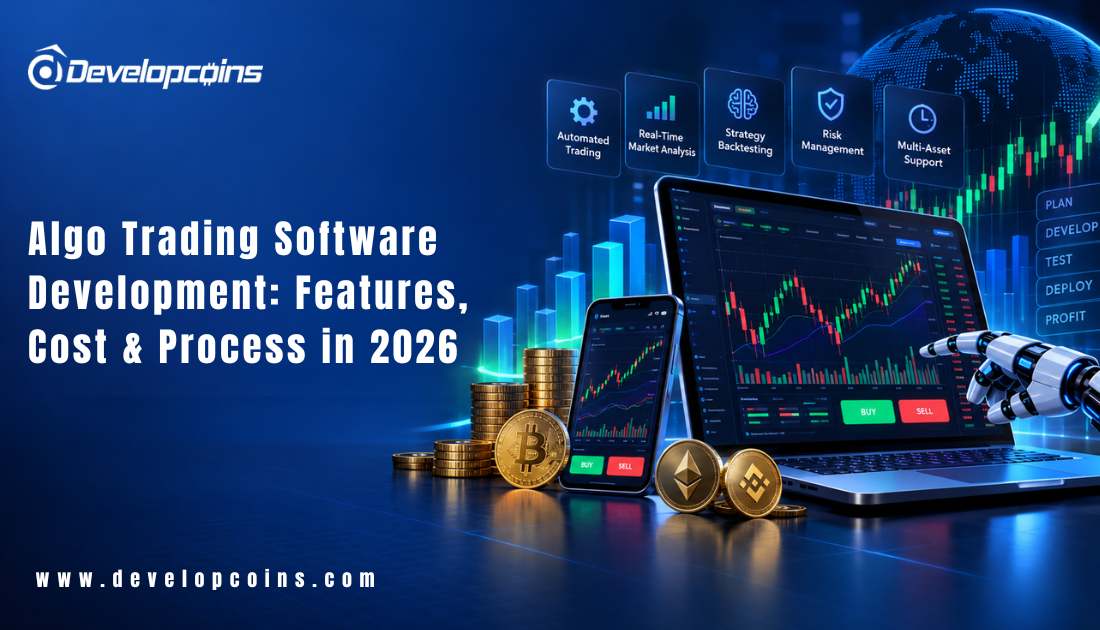
The fact that the cryptocurrency markets run 24/7, makes the trading and investment business very difficult to analyze prices, analyze strategies and make the trade manually all times. Algo trading software addresses this challenge by automating trading decisions based on predefined strategies, market data, and execution rules. This makes it useful for trading firms, exchanges, fintech startups, and businesses planning to launch automated trading products.
What Is Algo Trading Software?
Algo trading software is a platform that uses programmed rules to analyze market conditions and execute trades automatically. Instead of relying entirely on manual decisions, traders can configure strategies around price movements, technical indicators, trading volume, market trends, or specific entry and exit conditions.
In crypto markets, automated trading is particularly useful because markets operate continuously across multiple exchanges and assets. The software can monitor selected markets and execute trades according to configured parameters without requiring constant manual intervention.
Businesses can develop the software as a standalone trading platform, integrate it with an existing crypto exchange, or offer automated trading capabilities directly to customers.
Why Businesses Use Algo Trading Software
Manual trading becomes challenging as the number of markets, assets, and trading signals increases. Traders can miss opportunities, respond late to market movements, or struggle to maintain consistent execution.
Algo trading software can handle repetitive trading activities while allowing users to define how and when trades should take place.
Common business applications include:
- Automated order execution
- Strategy-based trading
- Real-time market monitoring
- Multi-asset trading
- Multi-exchange connectivity
- Risk and exposure management
- Portfolio tracking
- Backtesting and strategy evaluation
The required capabilities depend on the business model. A trading firm may need advanced strategy management, while a crypto exchange may require deeper integration with its matching engine, liquidity systems, APIs, and user accounts.
Types of Algo Trading Strategies
Algo trading software can support different strategies depending on the target market and trading model. Common approaches include:
Arbitrage trading - A arbitrage bot development identifies price differences for the same asset across markets or exchanges.
Market-making strategies - places buy and sell orders around market prices to capture spreads.
Trend-following - uses market direction and technical indicators to identify potential entry and exit points.
Mean-reversion trading - identifies situations where an asset moves away from its historical price range.
Grid trading - places multiple orders at predefined price intervals.
Momentum trading - uses price and volume movements to identify strong market activity.
The strategy engine can then be designed around the specific rules, risk limits, assets, and exchanges required by the business.
Core Features of Algo Trading Software
A commercially viable platform needs more than automated buying and selling. It should support the complete trading workflow.
Automated Strategy Execution
Users can configure strategies based on technical indicators, price conditions, arbitrage opportunities, market signals, or predefined rules that execute trades when these rules are met.
Real-Time Market Data
Reliable market data is essential for trading decisions. Exchange APIs and data providers can supply prices, order-book data, trading volume, and other market signals.
Backtesting
Backtesting lets traders test strategies against historical market data before using them in live trading, helping assess potential performance under different market conditions.
Risk Management
Risk controls can include stop-loss rules, position limits, maximum trade sizes, exposure restrictions, and automated order limits, reducing risks from unsupervised execution.
Exchange API Integration
Crypto algo trading platforms can connect with multiple centralized or decentralized exchange development to receive market data and submit orders based on trading logic.
Trading Dashboard
A centralized dashboard can display active strategies, open positions, completed trades, portfolio performance, market data, and account activity.
Strategy Management
Users can create, test, modify, pause, and monitor multiple strategies from one interface, with advanced platforms supporting simultaneous strategy execution
How Crypto Algo Trading Software Works
Crypto algo trading software follows a connected workflow, moving from market data to strategy analysis and automated order execution.
1. Market Data Collection
The software receives real-time prices, trading volume, order-book data, and other market information through exchange APIs or data providers.
2. Strategy Analysis
The strategy engine processes incoming data based on predefined trading rules, indicators, or conditions.
3. Risk Checks
Before placing an order, the system applies risk parameters such as position limits, trade-size restrictions, and stop-loss conditions.
4. Order Execution
When trading conditions are met, the execution engine generates and sends the order to the connected exchange.
5. Trade Monitoring
The platform records order status, executed trades, positions, and account activity for ongoing monitoring.
6. Performance Tracking
Trading data is analyzed to help users monitor strategy performance, trading activity, and portfolio results.
Algo Trading Software Development Process
Development begins with defining the business model and trading requirements. The process generally includes:
1. Requirement Analysis
Define the target users, trading workflows, strategies, supported markets, and revenue model for the crypto trading software project.
2. Architecture Planning
Design the trading engine, data layer, strategy engine, exchange connections, user management, and security architecture.
3. UI and Dashboard Development
Build interfaces for strategy configuration, trading activity, portfolio monitoring, and performance analysis.
4. Trading Engine Development
Develop the core system that processes market data, evaluates strategies, applies risk rules, and executes orders.
5. Exchange Integration
Connect selected crypto exchange development and test market-data and order-execution workflows.
6. Testing and Backtesting
Test strategies against historical data and evaluate the software under different trading and load conditions.
7. Deployment and Maintenance
Deploy the platform, establish monitoring systems, address security requirements, and provide ongoing technical maintenance.
Algo Trading Software vs Trading Bots: Build or Buy?
A crypto trading bot development automate specific strategies, while algo trading software supports broader functions such as strategy management, backtesting, risk controls, and exchange integration.
Ready-made bots suit traders looking for quick automation, but businesses often need greater control and customization. Custom algo trading software supports proprietary strategies, multiple exchanges, advanced risk management, and future expansion.
Buying reduces initial development time, while building offers greater control over features, security, and architecture. For long-term commercial platforms, custom development can provide greater flexibility.
Build Your Algo Trading Software
Algo trading software gives crypto businesses a way to automate strategy execution, monitor markets continuously, and manage digital-asset trading through a structured platform.
The right solution depends on the business model, trading strategies, target users, supported exchanges, and risk requirements. Building around these factors from the beginning can also prevent expensive architectural changes later.
If you are planning to launch an automated crypto trading platform or add algorithmic trading capabilities to an existing product, Developcoins as Cryptocurrency Development Company can help with algo trading software development, trading engine architecture, strategy integration, exchange APIs, risk management, and platform development. Get in touch with the team to discuss your requirements and receive a development roadmap for your project.

THE AUTHOR
DEVELOPCOINS EDITORIAL TEAM
Our Developcoins' Editorial Team brings over 10+ years of experience in blockchain, fintech, and AI-based technologies. We are a team of developers, analysts, and technical writers sharing insights from successful projects. We believe content should do more than inform. It should guide, clarify, and give readers the confidence to explore new technologies. To support this, we publish content backed by practical knowledge gained from working on live projects across industries.