

AI and Blockchain Integration - 10 Use Cases & Trends to Watch in 2026
Explore 10 AI and blockchain use cases shaping 2026, from autonomous agents and crypto trading to tokenization and payments, with insights from DevelopCoins.
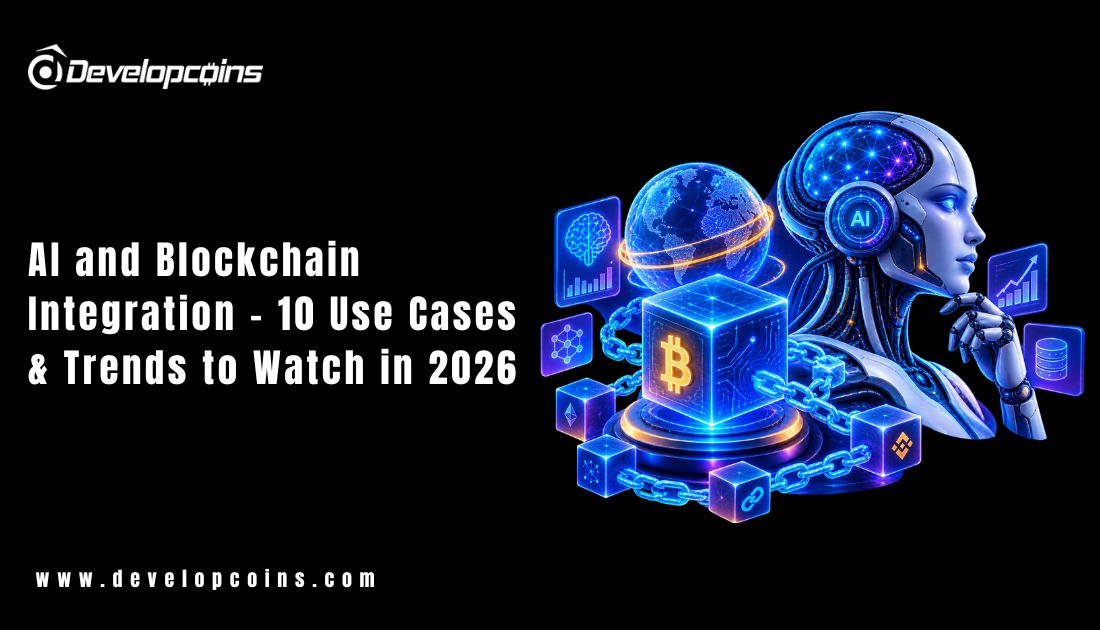
AI and blockchain are moving into practical business applications. AI handles analysis, prediction, and automation, while blockchain manages transactions, ownership, verification, and digital records.
Together, they support AI agents, crypto trading, tokenized assets, decentralized computing, digital identity, and programmable payments. The value comes from linking AI-driven decisions with blockchain-based verification and execution.
What Is AI and Blockchain Integration?
AI and blockchain integration combines AI capabilities with blockchain infrastructure in a single workflow.
AI analyzes data and makes decisions, while blockchain records transactions, manages digital assets, verifies ownership, and executes smart contracts. In most solutions, AI works off-chain while blockchain handles verification and settlement.
For example, an AI agent can analyze market conditions, decide to trade, and execute the transaction through a smart contract, combining AI-driven decisions with verifiable blockchain execution.
Why AI and Blockchain Is Important in 2026
The technologies complement each other. An AI development is built for understanding and acting on information, while blockchain is designed for recording and executing value-based activity.
Together, they can support:
- AI agents operating with defined permissions
- Smart contracts executing business rules
- Blockchain-based transaction and ownership records
- AI analysis of on-chain and off-chain data
- Stablecoin-based automated payments
- Tokenized assets and programmable applications
- Decentralized AI computing and service marketplaces
Circle's 2026 Agent Stack, for example, includes agent wallets, an agent marketplace, and nanopayments that allow AI agents to hold assets and transact programmatically using USDC. This reflects a broader shift toward AI systems that can take controlled actions rather than simply provide recommendations.
10 Real-World AI and Blockchain Use Cases in 2026
1. AI Agents for Autonomous Payments
AI agents are increasingly being designed to perform transactions under predefined permissions.
Circle's Agent Stack supports AI agents with wallets and infrastructure for programmatic USDC transactions, while Coinbase's x402 provides infrastructure for machine-to-machine payments.
Businesses can use this model for agents that purchase APIs, data, computing resources, and digital services without requiring manual approval for every transaction.
2. AI-Powered Crypto Trading
AI can process market data, identify patterns, generate trading signals, and assess risk. Blockchain networks and exchange APIs then provide the execution and settlement layer.
ChainGPT combines Web3 AI capabilities with crypto-market analysis and AI trading tools, demonstrating how AI can become part of crypto-focused financial infrastructure.
This model can support AI-powered trading software, portfolio management platforms, strategy engines, and automated risk systems.
3. AI-Assisted Smart Contract Security
Smart contracts control assets and business logic, making security a critical development requirement.
AI can assist with code analysis by identifying suspicious patterns, vulnerabilities, and access-control issues before deployment.
ChainGPT's Smart Contract Auditor analyzes Solidity contracts and generates automated audit reports. AI does not replace professional security audits, but it can support development, testing, and vulnerability detection.
4. Decentralized AI Compute
AI applications require substantial computing resources for training and inference. Decentralized networks connect users with independent providers of CPU and GPU resources.
Akash Network operates a decentralized cloud marketplace where providers supply computing resources. Its documentation states that compute can be available at prices up to 85% lower than traditional cloud providers.
Here, blockchain coordinates the marketplace and economic incentives while distributed infrastructure supplies AI computing power.
5. Blockchain-Based AI Networks
Blockchain can coordinate contributors to AI networks rather than simply supporting an individual AI application.
Bittensor uses a subnet model where participants contribute services such as compute, inference, storage, and prediction. The network uses TAO-based incentives to reward contributions.
This model demonstrates how blockchain can create economic coordination around AI resources and services, opening opportunities for decentralized AI marketplaces.
6. AI + Blockchain for Supply Chains
AI can analyze supply-chain data for demand forecasting, anomaly detection, and logistics planning, while blockchain can provide a shared record of product movement.
IBM Food Trust is an example of blockchain being used for food traceability through a permissioned network that allows supply-chain participants to share data.
Adding AI to this infrastructure can support supplier-risk analysis, route planning, forecasting, and anomaly detection.
7. AI-Driven Digital Identity
AI-based systems can process documents, biometric information, and behavioral signals, while blockchain-based infrastructure can provide verifiable credentials and proofs.
World ID demonstrates this direction through a privacy-preserving identity protocol that allows users to prove they are real and unique online using zero-knowledge technologies.
For Web3 applications, similar infrastructure can support bot prevention, account access, rewards, governance, and identity verification.
8. AI + Blockchain for Tokenized Assets
Blockchain is becoming increasingly relevant to tokenized financial assets, while AI can add analysis and decision-support capabilities.
J.P. Morgan's Kinexys provides institutional blockchain infrastructure for digital assets, including tokenized funds and collateral, with programmable on-chain activity and settlement.
AI can complement tokenization platforms through portfolio analysis, risk scoring, compliance workflows, and asset monitoring.
9. AI + Blockchain for Healthcare Data
Healthcare applications require both intelligent data analysis and strong controls over sensitive information.
Blockchain can provide auditable records for permissions and data access, while AI can analyze approved datasets for operational or clinical applications.
Platforms such as MediChain demonstrate blockchain-based approaches to healthcare records, access management, consent, and AI-assisted document processing.
Sensitive patient information should generally remain in secure storage rather than being placed directly on a public blockchain.
10. AI-Powered Payments and Stablecoin Transactions
Payments could become one of the strongest commercial applications of AI and blockchain.
Mastercard's Agent Pay for Machines supports AI-agent transactions with controls, authentication, and traceability. In June 2026, Mastercard announced more than 30 participants, including Coinbase, Cloudflare, OKX, and Stripe.
Visa is also developing Intelligent Commerce to provide AI agents with tokenized payment credentials and transaction controls.
Combined with stablecoins, these technologies can support machine-to-machine commerce, automated service payments, and controlled agent transactions.
Business Benefits of AI and Blockchain Integration
When both technologies have clearly defined roles, businesses can gain:
Intelligent automation - AI handles analysis while smart contract development executes predefined actions.
Greater traceability - Blockchain creates verifiable records of transactions and ownership.
Programmable payments - Stablecoins and smart contracts support automated settlement.
New digital products - Businesses can build AI agents, trading platforms, tokenization systems, and Web3 applications.
Better risk management - AI identifies patterns while blockchain provides transaction history.
New revenue model - AI services, tokenized assets, compute marketplaces, and machine-to-machine payments create new commercial opportunities.
AI and Blockchain Trends to Watch in 2026
Autonomous AI Agents
As AI agent development is moving from generating responses to performing tasks, using wallets and programmable payments to transact within set limits.
Agentic Payments
Mastercard, Visa, and Circle are developing infrastructure for controlled AI-agent transactions, supporting machine-to-machine commerce and automated payments.
Decentralized AI Infrastructure
Networks such as Akash and Bittensor use blockchain to coordinate distributed computing, AI services, and incentives.
AI-Powered Tokenization
As assets move on-chain, AI Token development can support valuation, monitoring, risk assessment, and compliance for tokenized assets.
Verifiable AI
As AI handles more decisions, businesses need to verify data, model activity, and actions. Blockchain can provide this verification layer without running AI entirely on-chain.
Build an AI + Blockchain Solution in 2026
AI and blockchain integration is moving from experimentation to practical product development. AI provides intelligence and automation, while blockchain handles ownership, verification, transactions, incentives, and settlement.
Businesses can use this combination to build AI agent platforms, crypto trading systems, decentralized AI marketplaces, tokenization platforms, stablecoin payment solutions, and other Web3 applications.
Building these solutions requires the right mix of AI architecture, blockchain infrastructure, data strategy, security, and integrations. Developcoins, a Blockchain Development Company and AI development company, helps businesses build AI-powered blockchain solutions based on their use case, technology requirements, and product goals.

THE AUTHOR
DEVELOPCOINS EDITORIAL TEAM
Our Developcoins' Editorial Team brings over 10+ years of experience in blockchain, fintech, and AI-based technologies. We are a team of developers, analysts, and technical writers sharing insights from successful projects. We believe content should do more than inform. It should guide, clarify, and give readers the confidence to explore new technologies. To support this, we publish content backed by practical knowledge gained from working on live projects across industries.
 How Crypto Market Making Bots Improve Exchange Liquidity and Reduce Slippage