




Cross-Platform Game Development: A Complete Guide to Its Pros and Cons
Planning a multi-platform game? Explore the benefits, challenges, engines, and costs of cross-platform development, with insights from Developcoins on building games for multiple devices.
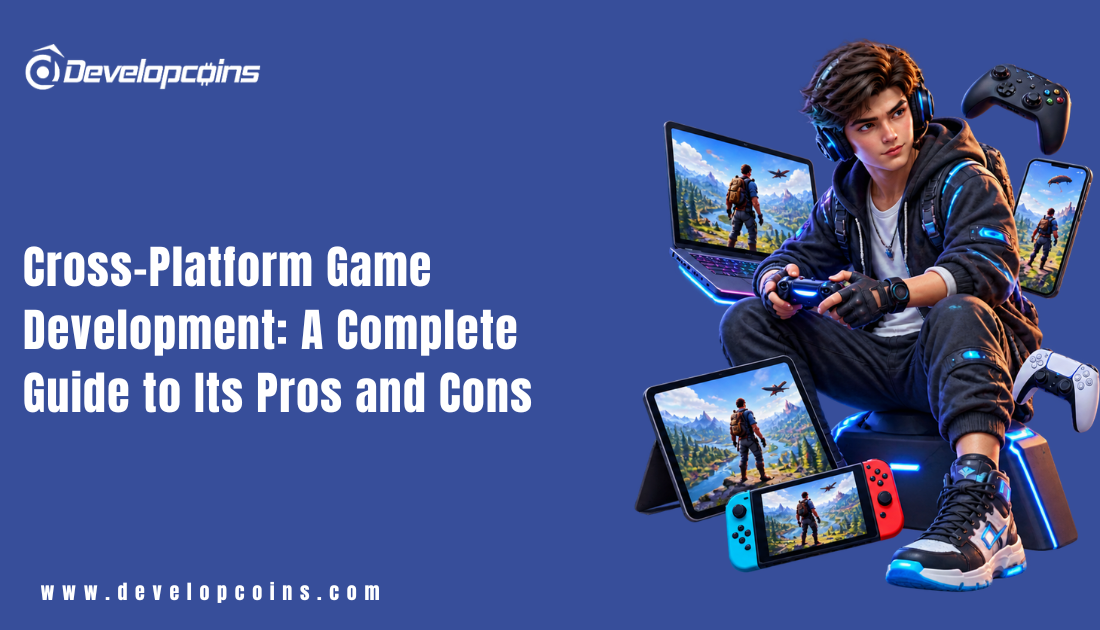
Gaming is no longer tied to one device. Players can enjoy the same types of games on PCs, consoles, smartphones, and web browsers, depending on their preferences and hardware. For studios, this opens up more ways to reach different player groups, but supporting multiple platforms can also mean more development time, testing, and higher costs.
This is where cross-platform game development comes in. It allows developers to reuse core game systems across different platforms while adapting controls, UI, graphics, and other features to suit each platform.
What Is Cross-Platform Game Development?
Cross-Platform Development is defined as an approach for developing a game on a common game engine, same assets and development tools so it can be played on many platforms such as Windows, mac OS, android, iPhone, ps, xbox, Nintendo Switch and web browsers etc. This type of game development involves building basic systems of the game and after that optimizing it according to the individual platforms’ preferences.
Pros of Cross-Platform Game Development
Wider Player Reach
Cross-platform development allows games to reach players across PC, mobile game development, consoles, and web platforms. A single game can serve audiences with different device preferences and create more opportunities for distribution.
Key benefits include:
- Access to players across PC, mobile, console, and web platforms.
- Greater potential for audience and community growth.
- More distribution opportunities for the same game.
- Wider platform availability for multiplayer games.
Lower Development Costs
Cross-platform development can reduce costs by allowing teams to reuse core code, game systems, and development assets. Developers may not need separate projects for every platform, although the final cost depends on game complexity and platform-specific requirements.
Cost-saving areas can include:
- Reusable gameplay code
- Shared backend and networking systems
- Common game assets and development tools
- Reduced need for separate development teams
Faster Development
A shared codebase can reduce repetitive programming when preparing a game for multiple platforms. Developers can build core systems once and adapt them for different devices, which may support a shorter development cycle.
Development advantages include:
- Less duplicate programming work
- Reusable core game systems
- Easier preparation for multiple platform builds
- Potentially shorter development cycles for multi-platform releases
Easier Maintenance and Updates
A shared project can simplify certain maintenance tasks across multiple platforms. When developers fix a common game system, the update can often be applied to several builds. However, each version still needs testing after major changes.
Maintenance benefits can include:
- Shared fixes for common game systems
- Easier management of common features
- Consistent updates across supported platforms
- Less duplication in ongoing development work
Better Resource Utilization
Cross-platform development allows programmers, designers, artists, and testers to work around a common project instead of maintaining completely separate versions. This can be especially useful for smaller teams with limited resources.
Teams can make better use of resources through:
- Shared development workflows
- Reusable programming and design work
- Common testing processes
- Better allocation of smaller development teams
Cons of Cross-Platform Game Development
Cross-platform development is not without challenges. Supporting multiple platforms introduces additional technical considerations, particularly when a game has demanding graphics, complex mechanics, or platform-specific features.
Platform-Specific Limitations
Each gaming platform has different hardware, operating systems, APIs, memory limits, input methods, and publishing requirements. A feature that works well on a high-end PC may require changes when released on mobile or other lower-powered devices.
Common limitations include:
- Differences in hardware capabilities
- Platform-specific APIs and services
- Different memory and storage limits
- Variations in input methods
- Separate publishing requirements
Performance and Optimization Challenges
Game performance can vary across platforms. A title that runs smoothly on a gaming PC may require lower texture quality, fewer visual effects, or different graphics settings on mobile hardware. These changes can add development work.
Performance considerations include:
- Frame rate and resolution
- Memory and storage usage
- Loading times
- Graphics quality
- Device hardware capabilities
- Battery consumption on mobile devices
Additional Testing Requirements
Supporting multiple platforms increases the number of devices and configurations that need testing. Developers must check whether gameplay, graphics, networking, controls, and UI work correctly across different hardware and operating systems.
Testing may cover:
- Gameplay and functionality
- Device compatibility
- Graphics and performance
- Multiplayer connectivity
- Controller and touch controls
- UI and screen layouts
UI and Control Compatibility Issues
Players use different input methods depending on their platform. Mobile games rely on touch controls; PCs commonly use keyboards and mice, while consoles use controllers. A single interface may not work equally well across all devices.
Platform-specific adjustments may include:
- Touchscreen controls for mobile
- Keyboard and mouse controls for PC
- Controller layouts for consoles
- Different button prompts
- Adapted menus and HUD elements
- Different screen and UI layouts
Platform Certification Requirements
Each platform has its own publishing and certification rules. Console stores, mobile app stores, and PC marketplaces may have requirements related to functionality, content, payments, privacy, performance, and user accounts.
Certification may involve:
- Platform technical requirements
- Content and functionality checks
- Payment and account requirements
- Privacy and security requirements
- Performance checks
- Store submission guidelines
Which Games Benefit Most From Cross-Platform Development?
Cross-platform development suits games that need broad reach without heavy platform-specific requirements.
Multiplayer Games - Reach players across PC, mobile, and consoles.
Casual and 2D Games - Simpler mechanics and lower hardware demands make multi-platform releases easier.
Indie Games - Share development resources while reaching multiple markets.
Live-Service Games - Manage updates, events, and content across supported platforms.
Platform-Specific Games - Advanced graphics or specialized hardware may require more native development
Popular Tools and Engines for Cross-Platform Game Development
Unity
An Unity game development supports mobile, PC, console, and web development, making it a popular choice for indie and commercial game projects.
Unreal Engine
An Unreal Engine game development is widely used for high-quality 3D games and supports PC and console development with C++ and visual development tools.
Godot
Godot is an open-source engine supporting 2D and 3D games, making it suitable for independent developers and smaller studios.
GameMaker
GameMaker is mainly used for 2D games and supports projects such as platformers, arcade games, and pixel-art titles.
Defold
Defold is a lightweight cross-platform engine that is particularly suitable for 2D games and smaller projects.
How to Choose the Right Approach for Your Game
Choosing between cross-platform and native development depends on the game's technical and business requirements.
Target platforms - Identify where your target players are most active, whether that means Android game development, iOS, PC, console, or web platforms.
Game complexity - Consider graphics, physics, AI development, multiplayer, world size, and networking requirements.
Development costs - Account for development, testing, certification, platform integration, maintenance, and post-launch expenses.
Engine support - Check platform compatibility, required features, programming language, integrations, and licensing.
Platform-specific work - Plan for adjustments to controls, UI, graphics, payments, and online services.
Future plans - Consider whether additional platforms may be added after launch and plan the game architecture accordingly.
Is Cross-Platform Game Development Worth It?
Cross-platform game development allows studios to bring the same game experience to many different players on different platforms while sharing core development materials. With cross-platform development, they can reuse much of the code and potentially reduce development costs, so it may be the right choice and approach for many game projects.
An experienced Game Development Company like DevelopCoins can help businesses choose the right approach and build projects across mobile, multiplayer, 2D, and 3D game development, along with game UI/UX and other supporting services. We help businesses plan their target platforms, select suitable development tools, build core gameplay systems, and prepare games for multi-platform deployment. This makes it a relevant option for studios looking to take a game from concept through development and launch.

THE AUTHOR
DEVELOPCOINS EDITORIAL TEAM
Our Developcoins' Editorial Team brings over 10+ years of experience in blockchain, fintech, and AI-based technologies. We are a team of developers, analysts, and technical writers sharing insights from successful projects. We believe content should do more than inform. It should guide, clarify, and give readers the confidence to explore new technologies. To support this, we publish content backed by practical knowledge gained from working on live projects across industries.