


EU Digital Identity Wallet 2026 - Complete Guide for eIDAS 2.0 & Web3 Founders
This guide explains the EU Digital Identity Wallet under eIDAS 2.0, including its legal framework, rollout timeline, key features, and real-world use cases for businesses and developers preparing for 2026 adoption.
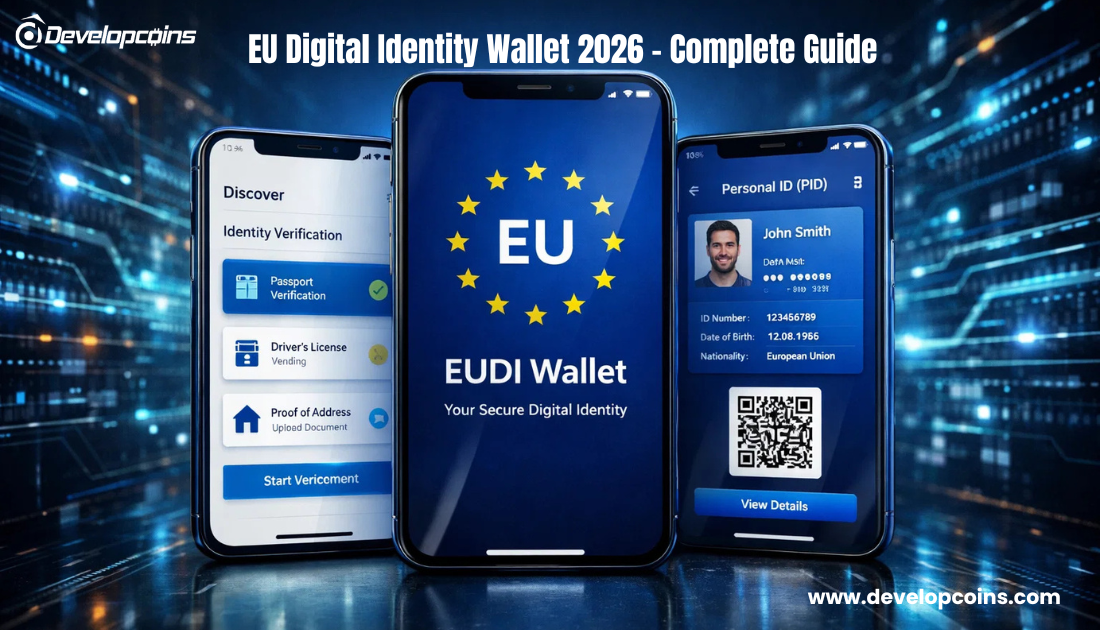
EU Digital Identity Wallets are secure mobile apps required by EU law. This app let people and businesses prove their identity, share their verified information, and sign documents digitally. By the end of 2026, every EU country must provide at least one wallet, and from 2027, many private companies will also need to accept them. This blog explains what these wallets are, how they work, why they are important, and how organizations can adapt them.
What Is an EU Digital Identity Wallet?
An EU Digital Identity Wallet is a secure mobile app that stores verified digital credentials issued by trusted public or private entities. These credentials can be used to prove identity or specific attributes both online and offline.
Earlier national eID systems, EUDI Wallets are designed to work effortlessly across all EU countries and across both public and private services. The user remains in control of what information is shared, with whom, and for what purpose.
Why the EU Introduced Digital Identity Wallets?
Before EUDI Wallets, digital IDs in Europe were all over the place and didn’t work well together. Most digital IDs worked only within a single country and were rarely accepted by private companies. Because cross-border services required repeated document uploads and manual checks.
The EU introduced EUDI Wallets to create a unified framework that,
-
Works across all Member States.
-
Supports both public and private-sector services.
-
Strengthens privacy and user control.
-
Reduces reliance on passwords and document uploads.
eIDAS 2.0 and the Legal Framework
EU Digital Identity Wallets are governed by eIDAS 2.0, officially Regulation (EU) 2024/1183. This regulation modernizes the original eIDAS framework and introduces mandatory digital identity wallets at EU level.
What changed under eIDAS 2.0?
Under eIDAS 2.0, The regulation introduces legally recognized EU Digital Identity Wallets that can be used for onboarding, authentication, and electronic signatures across borders and across both public and private services.
To make sure that these wallets work throughout the EU, the regulation requires them to follow common EU standards. These shared specifications and interfaces allow wallets issued in one Member State to be accepted and trusted in another, while maintaining high levels of security and privacy.
Obligations for Member States
Each EU country must,
-
Provide at least one compliant EUDI Wallet.
-
Assure interoperability with other EU wallets.
-
Issue verified Person Identification Data (PID).
-
Obligations for private-sector providers.
Certain private entities must accept EUDI Wallets when requested, particularly in regulated sectors such as finance, telecom, and large online platforms.
Timeline and Rollout Milestones
The rollout of EU Digital Identity Wallets follows a fixed legal timeline.
2021–2023 - Large-scale pilots and technical trials.
May 2024 - Regulation enters into force.
December 2024 - Implementing acts and technical standards apply.
December 2026 - All Member States must offer at least one wallet.
December 2027 - Mandatory private-sector acceptance begins.
This timeline leaves limited time for platforms to adapt their identity and onboarding flows.
Core Components of an EU Digital Identity Wallet
Every EUDI Wallet is built around verified credentials issued by trusted authorities.
1. Person Identification Data (PID)
PID is government-issued identity data which confirms who the user is. It acts as the root of trust for all other credentials stored in the wallet.
2. Electronic Attestations of Attributes (EAAs)
EAAs are credentials issued by public or private organizations. Examples include driving licenses, diplomas, professional certifications, or proof of age.
3. Key ecosystem roles
The EUDI ecosystem involves three main actors,
-
Wallet issuers, who provide the wallet application.
-
Credential issuers, who issue and sign verified data.
-
Relying parties, who request identity or attribute verification.
Privacy, Security, and User Control
Privacy is a core principle of EUDI Wallets. Users always decide what data is shared and for what purpose.
Key privacy and security capabilities of EU Digital Identity Wallets include users sharing only the data required for a service. Every transaction must require user consent, which shows giving individuals full control over how and when their information is used. Credentials are protected using strong cryptographic mechanisms, and recorded activity logs are visible to the user, providing transparency and accountability.
In some cases, advanced techniques such as zero-knowledge proofs may be used to verify information without revealing underlying data.
Key Features and Capabilities
EU Digital Identity Wallets support a broad range of functions that go far beyond simple login, which are,
1. Digital Identification and Authentication - Users can prove their identity securely without relying on passwords.
2. Legally Valid Electronic Signatures - Documents can be signed digitally with full legal recognition across the EU.
3. Attribute Verification - Only required details, such as age or residence, are shared to protect privacy.
4. Credential Portability - Verified credentials can be moved between compliant wallets without lock-in.
5. Secure Recovery - Users can safely regain access if their device is lost.
These features make EUDI Wallets suitable for both everyday use and high-trust transactions.
Supported Credentials and Real-World Use Cases
EUDI Wallets can store many types of credentials, and the list will grow over time.
Common credentials include national IDs, residence permits, mobile driving licenses, and educational certificates. These access practical use cases such as bank onboarding, remote KYC, job applications, cross-border university enrollment, and access to public services in other EU countries.
By reducing manual checks, EUDI Wallets lower costs and improve user experience.
Conclusion
EU Digital Identity Wallets are transforming digital identity in Europe by offering secure, privacy-focused ways to verify identity, share credentials, and sign documents under the eIDAS 2.0 framework.
For businesses and developers, this is a chance to improve and simplify processes like identity verification, customer onboarding, and signing documents digitally. Developcoins is a trusted blockchain development company that supports this transition by providing EUDI Wallet development, compliant solutions, including secure wallet integrations, crypto-ready identity verification, and scalable digital identity platforms, helping organizations stay compliant while utilising the future of trusted digital identity.

THE AUTHOR
DEVELOPCOINS EDITORIAL TEAM
Our Developcoins' Editorial Team brings over 10+ years of experience in blockchain, fintech, and AI-based technologies. We are a team of developers, analysts, and technical writers sharing insights from successful projects. We believe content should do more than inform. It should guide, clarify, and give readers the confidence to explore new technologies. To support this, we publish content backed by practical knowledge gained from working on live projects across industries.