
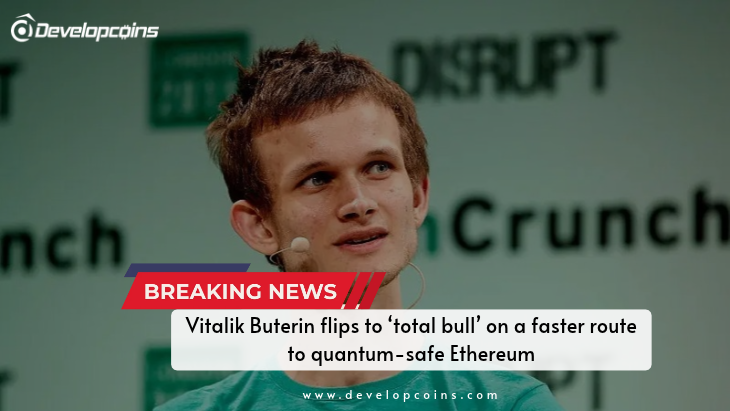
Vitalik Buterin flips to ‘total bull’ on a faster route to quantum-safe Ethereum
 Nov 16, 2026
A proposed system would combine bulky digital signatures into a shared proof, helping protect wallets without making every payment much more expensive.
Ethereum co-founder Vitalik Buterin is backing a technique to guard the blockchain against quantum computers without saddling users with the cost of storing much larger digital signatures.
“Over the past few weeks I’ve gone from thinking leanPCS is total bull to being a total bull,” Buterin wrote in a post on X, referring to the approach.
A standard Ethereum signature takes up 65 bytes. Some quantum-resistant alternatives require about 1,000 to 6,000 bytes, according to Buterin, and certain cryptographic proofs used by privacy applications would also expand.
Storing that data onchain would consume more of Ethereum’s limited block space, which could push up the fees users pay to send tokens or interact with applications.
How the plan would work
Buterin’s proposed solution, outlined in EIP-8288, lets computers combine those checks before transactions reach the blockchain.
A wallet would still generate a signature proving its owner approved a payment. Computers receiving it would combine it with other signatures and proofs, then combine those batches again. Eventually, a block would contain one mathematical proof confirming that all the included checks passed.
Ethereum would retain the payment instructions and enough information to verify that shared proof, without permanently storing every bulky signature separately.
The approach could also help privacy applications, which use mathematical proofs to show that a transaction follows the rules without revealing its private details. Bundling those proofs could make stronger privacy practical without requiring each user to pay for the full amount of data their proof contains.
Buterin now favors leanPCS as a way to introduce that system sooner.
A broader alternative would require Ethereum developers to agree on a new computing language for the programs whose work the network verifies. That is a substantial decision, he said, because it would be difficult to change later.
LeanPCS would instead standardize a smaller mathematical checking tool that different proof systems could use. Developers would retain more freedom to choose how they build the rest. Buterin said that could deliver similar flexibility sooner, although it would require more information onchain than the broader alternative.
The proposal follows calls from researchers last week to prioritize quantum defenses over faster blocks in Ethereum’s planned 2027 upgrade.
EIP-8288 remains a draft, and its published specification still lists its reference implementation as unfinished. Buterin’s endorsement sets no launch date.
View Sources >> Vitalik Buterin flips to ‘total bull’ on a faster route to quantum-safe Ethereum